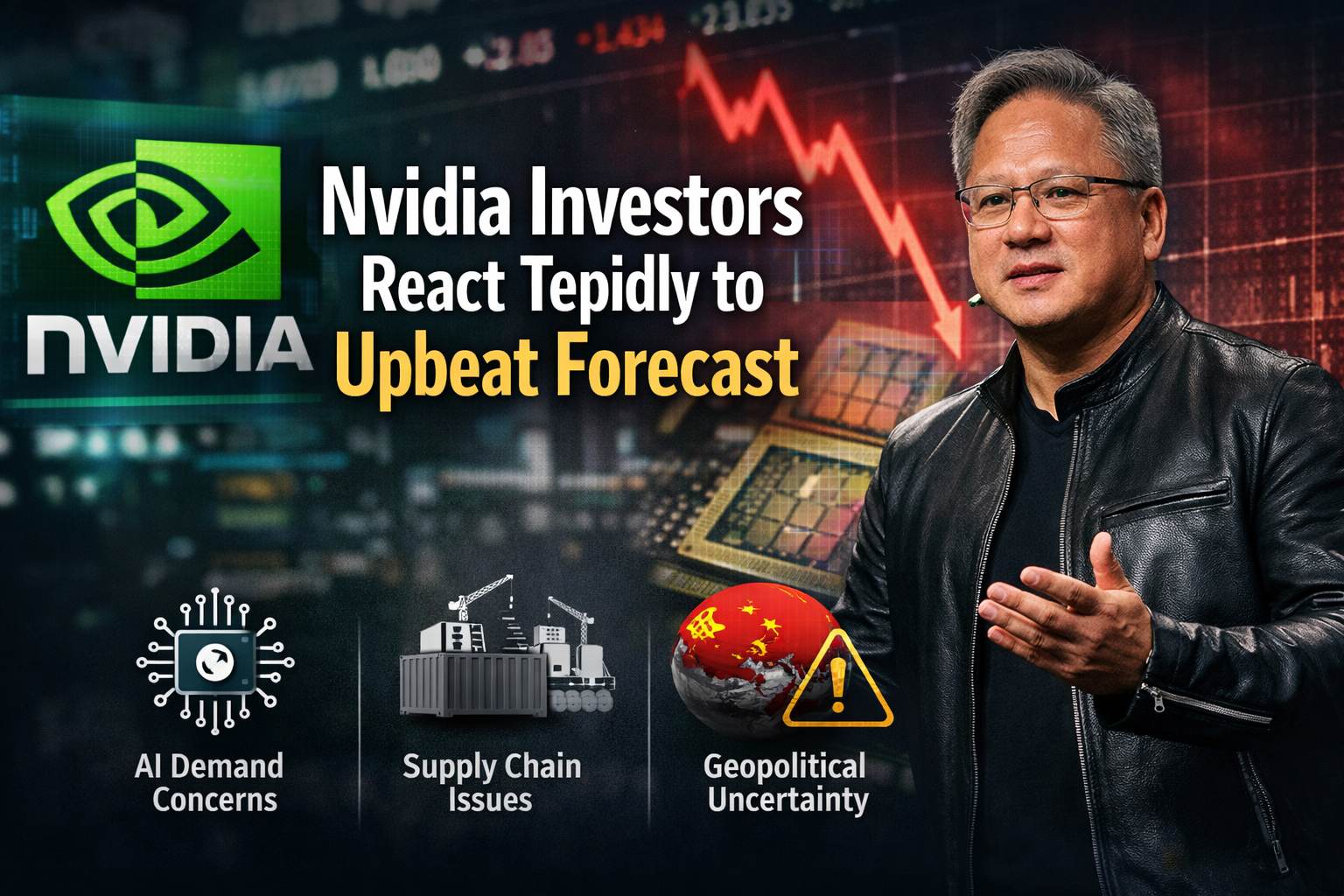
Nvidia Corp., the leading maker of artificial intelligence and high-performance computing chips, recently announced an upbeat fiscal first-quarter sales forecast that surpassed Wall Street expectations. However, instead of rallying on the news, investors reacted tepidly, with Nvidia shares slipping as much as 1.5% during market trading. The mixed response highlights underlying concerns in the AI ecosystem and the broader semiconductor industry despite strong performance metrics.
Let’s unpack why investors reacted cautiously, what the results showed, and what this means for Nvidia’s future — with key takeaways, expert analysis, and implications for the market.
📊 Strong Results, But Tepid Market Reaction
Contents
Record Results and Bullish Forecast
Nvidia reported remarkable revenue growth in its fiscal fourth quarter, generating about $68.1 billion in revenue, beating analysts’ forecasts and demonstrating exponential year-over-year growth. The company also projected fiscal first-quarter revenue of around $78 billion, which far exceeded the consensus estimate of roughly $72.8 billion compiled by Bloomberg.
Key highlights from the results included:
-
📈 Fiscal Q4 revenue: +73% year-over-year to $68.1B
-
📊 Adjusted EPS: beat expectations
-
💹 Forecasted Q1 revenue: ~$78B vs. consensus of ~$72.8B
Despite this strong outlook, Nvidia’s stock initially fell — reflecting investor caution rather than confidence.
Why the Tepid Market Response?
Several factors helped explain the subdued reaction:
-
Investor skepticism over sustained demand for AI hardware
-
Segment-specific underperformance, such as slower growth in gaming and automotive units
-
Broader market concerns about memory shortages and supply chain constraints
-
Geopolitical uncertainties, particularly in China
-
AI sector overheating worries and long-term sustainability questions
In short, even though Nvidia beat estimates, the market was expecting even more — and the degree of outperformance fell short of enthusiasm thresholds many investors had set.
📉 Headwinds: Skepticism Despite Strong Performance
1. Segment-Level Underperformance
While Nvidia’s data-center segment remained the primary driver of growth, gaming and automotive revenue lagged expectations. The gaming division generated roughly $3.73 billion, below analysts’ forecasts, and automotive sales also came in smaller than expected.
This mixed performance sent conflicting signals:
-
📌 Data center chips — powering AI workloads — continue to dominate
-
📌 Traditional business segments are no longer offsetting fluctuations
This uneven segment performance can reduce investor confidence, especially in cyclic industries.
2. Supply and Geopolitical Challenges
Nvidia’s supply chain faced challenges, especially due to memory chip shortages, which inflated costs and slowed production. At the same time, uncertainty about China — a key growth region — made revenue forecasting more difficult.
Although Nvidia secured enough components to meet demand, the unpredictability of China’s approval process for advanced chips adds risk that markets penalize.
3. AI Market Overheating Concerns
Analysts and investors are increasingly debating whether the AI hardware boom can maintain its momentum. Nvidia’s forecast was solid, but the scale of future demand remains uncertain — especially if AI hardware spending slows or enters a correction phase.
This sector-wide caution dampened enthusiasm even for a strong forecast.
💬 Management’s Response
Nvidia executives addressed investor concerns head on during their conference call.
Jensen Huang on Sustained Demand
CEO Jensen Huang pushed back on market skepticism, emphasizing that customers already see tangible returns from their computing investments, and that continued expenditure will drive future growth:
“You need compute capacity, and that translates directly to growth, and that translates directly to revenues…”
Supply and Production Comments
CFO Colette Kress reassured investors that Nvidia has secured inventory and future capacity commitments to support demand well into 2027. She also noted advancements in the company’s pipeline including next-generation Blackwell and Rubin chip platforms.
🔍 What This Means for Investors
📌 Long-Term AI Leadership
Despite the tepid reaction, Nvidia remains the central player in AI chip technology. Its data-center revenue continues to expand rapidly, reaffirming its dominance in high-performance computing — the backbone of generative AI, cloud infrastructure, and enterprise AI workloads.
📉 Short-Term Volatility Likely
Even strong guidance won’t always guarantee a positive share price reaction. Market expectations have become very high, and investors now weigh growth sustainability against valuation and broader economic factors.
⚠️ Risk Factors to Watch
-
Supply constraints and raw material costs
-
Regulatory or geopolitical actions impacting major markets
-
Competitive pressure from rival chipmakers
-
Shifts in AI hardware demand growth curves
📊 Bottom Line
Nvidia’s recent fiscal results and optimistic forecast reflect robust business performance and sustained leadership in AI infrastructure. However, the stock market’s tepid reaction underscores deeper investor concerns about the sustainability of rapid AI-related growth and segment performance variability.
For investors, this moment serves as a reminder that market expectations and sentiment matter just as much as company fundamentals — especially in fast-moving sectors like AI and semiconductors.