
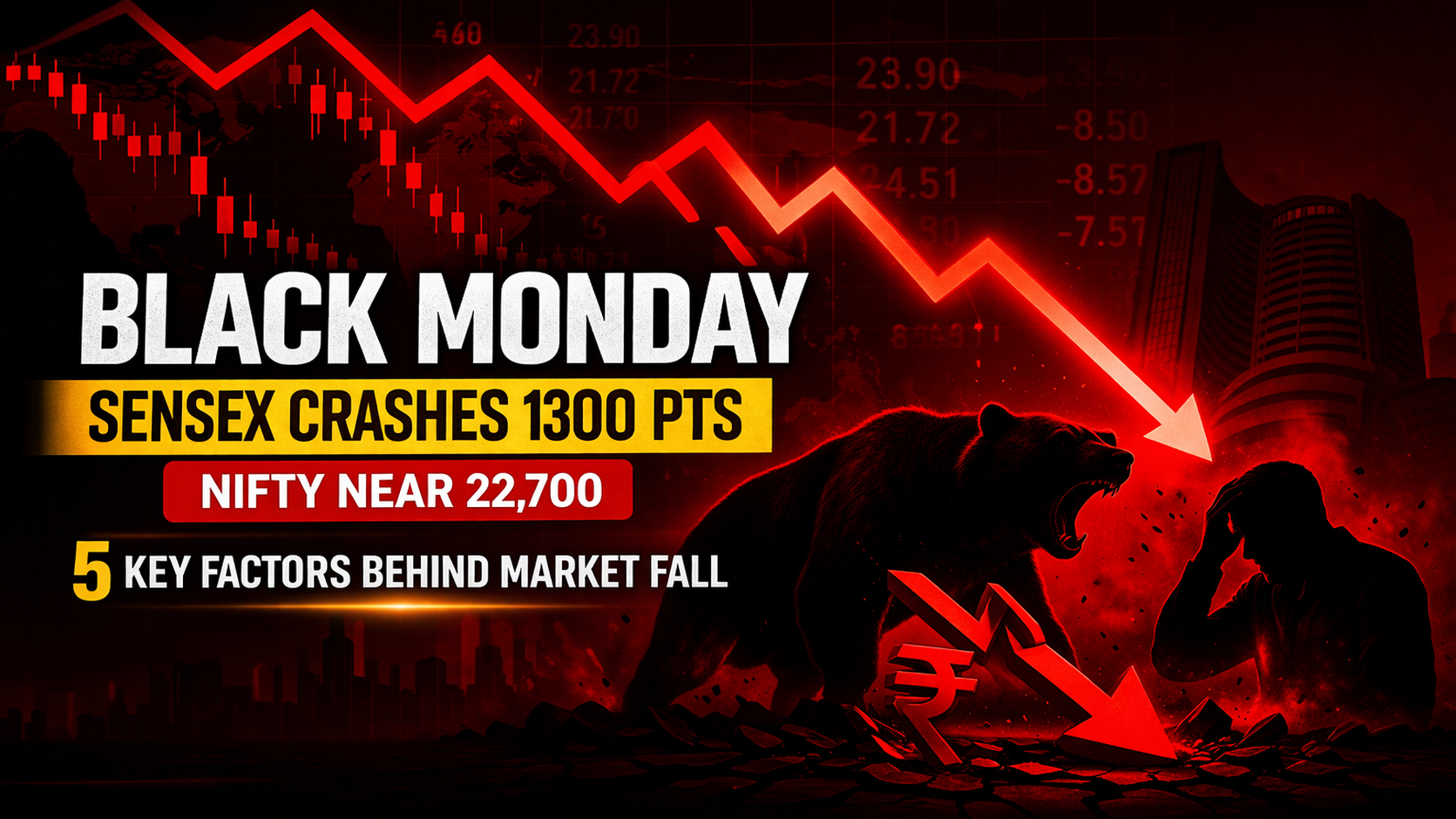
Indian stock markets witnessed a sharp sell-off on what is now being called Black Monday, as the Sensex crashed over 1300 points and the Nifty slipped close to 22,700 levels. The sudden fall has triggered panic among retail investors and raised concerns about short-term market stability.
This steep decline comes amid a mix of global and domestic factors, including weak global cues, rising bond yields, and heavy selling in IT and banking stocks. Let’s break down the five key reasons behind today’s market crash.
Market Overview
Contents
- Sensex: Down 1300+ points
- Nifty 50: Near 22,700
- Bank Nifty: Sharp decline led by banking stocks
- IT Stocks: Major losers in today’s session
The broader market also remained under pressure, with midcap and smallcap stocks witnessing heavy selling.
1. Weak Global Cues
One of the biggest reasons behind the crash is negative sentiment in global markets. Asian and US markets showed weakness due to concerns over inflation and interest rates.
Investors are worried that central banks, especially the US Federal Reserve, may keep interest rates higher for longer. This has reduced risk appetite globally, impacting emerging markets like India.
2. Rising US Bond Yields
The surge in US Treasury yields has made equities less attractive. Higher yields often lead to capital outflows from emerging markets as investors shift funds to safer assets.
This has directly impacted Indian markets, leading to foreign institutional investors (FIIs) pulling out money, which triggered selling pressure.
3. Heavy Selling in IT Stocks
The IT sector was among the worst hit in today’s session. Stocks like:
- Infosys
- TCS
- Wipro
witnessed significant declines.
The IT sector is highly dependent on global demand, especially from the US. Any slowdown fears or economic uncertainty directly affect these stocks.
4. Banking Stocks Under Pressure
Banking stocks also dragged the market lower. Major players like:
- HDFC Bank
- ICICI Bank
saw notable selling pressure.
Concerns around margin pressure, credit growth slowdown, and profit booking after recent rallies contributed to the decline in banking stocks.
5. Profit Booking After Recent Rally
Markets had been on a strong upward trend in recent weeks, with benchmark indices hitting record highs. This made valuations expensive.
As a result, investors chose to book profits, leading to a sharp correction. Such corrections are normal after a strong rally and help stabilize the market in the long term.
Sector-Wise Impact
- IT Sector: Biggest loser
- Banking & Financials: Significant decline
- Auto & FMCG: Relatively stable but under pressure
- Midcap & Smallcap: High volatility and selling
What Should Investors Do Now?
Market crashes often create panic, but they also present opportunities. Here are some key strategies:
1. Stay Calm and Avoid Panic Selling
Short-term volatility is part of the market. Avoid making emotional decisions.
2. Focus on Fundamentals
Invest in fundamentally strong companies with good long-term growth potential.
3. Use SIP Strategy
Systematic Investment Plans (SIPs) help average out costs during market volatility.
4. Look for Buying Opportunities
Quality stocks often become available at attractive valuations during corrections.
Expert View
Market experts believe that this correction is largely driven by global factors and profit booking rather than any major domestic weakness.
If global conditions stabilize, Indian markets could recover in the coming sessions.
Conclusion
The Sensex crash of 1300 points and the Nifty slipping near 22,700 on Black Monday has shaken investor confidence. However, the fall is driven by a combination of global uncertainty, rising yields, and sector-specific selling.
For long-term investors, this correction should be seen as a healthy phase rather than a warning sign. Staying disciplined and focusing on long-term goals is the key to navigating such volatile markets.